¿Por qué la limpieza láser representa una oportunidad de mercado desatendida?
Los métodos tradicionales de limpieza de superficies, como el chorro de arena, el decapado químico y la limpieza con hielo seco, han dominado el mantenimiento industrial durante décadas. Son eficaces, pero presentan serios inconvenientes: residuos peligrosos, permisos medioambientales, costes de los materiales, tiempo de limpieza y daños en los sustratos.
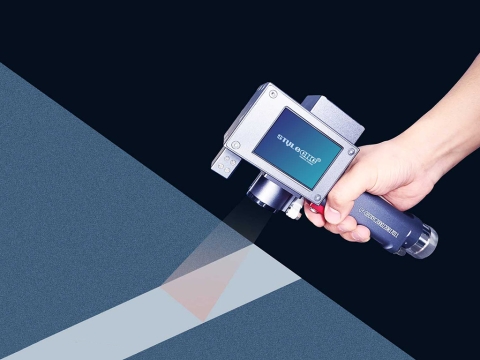
La limpieza láser elimina todos esos problemas. Un haz láser de fibra focalizado vaporiza el óxido, la pintura, las capas de óxido y los contaminantes sin tocar el metal base. Sin abrasivos. Sin productos químicos. Sin residuos secundarios. La superficie subyacente permanece intacta y lista para el recubrimiento o la soldadura.
A pesar de estas ventajas, la mayoría de los mercados locales no tienen proveedores móviles de limpieza láser. La tecnología ha estado disponible en entornos industriales durante años, pero la caída de los precios de los equipos a la $8,000 a $3La gama de precios de 0,000 ahora la hace accesible a operadores de servicios independientes. Esa brecha entre la creciente demanda y la baja competencia es la oportunidad.
Para un desglose lado a lado de cómo la limpieza láser se compara con los métodos tradicionales en términos de costo, velocidad e impacto ambiental, revise la comparación detallada de Limpieza láser frente a chorro de arena frente a chorro de hielo seco.
Cómo funciona el modelo de servicio móvil
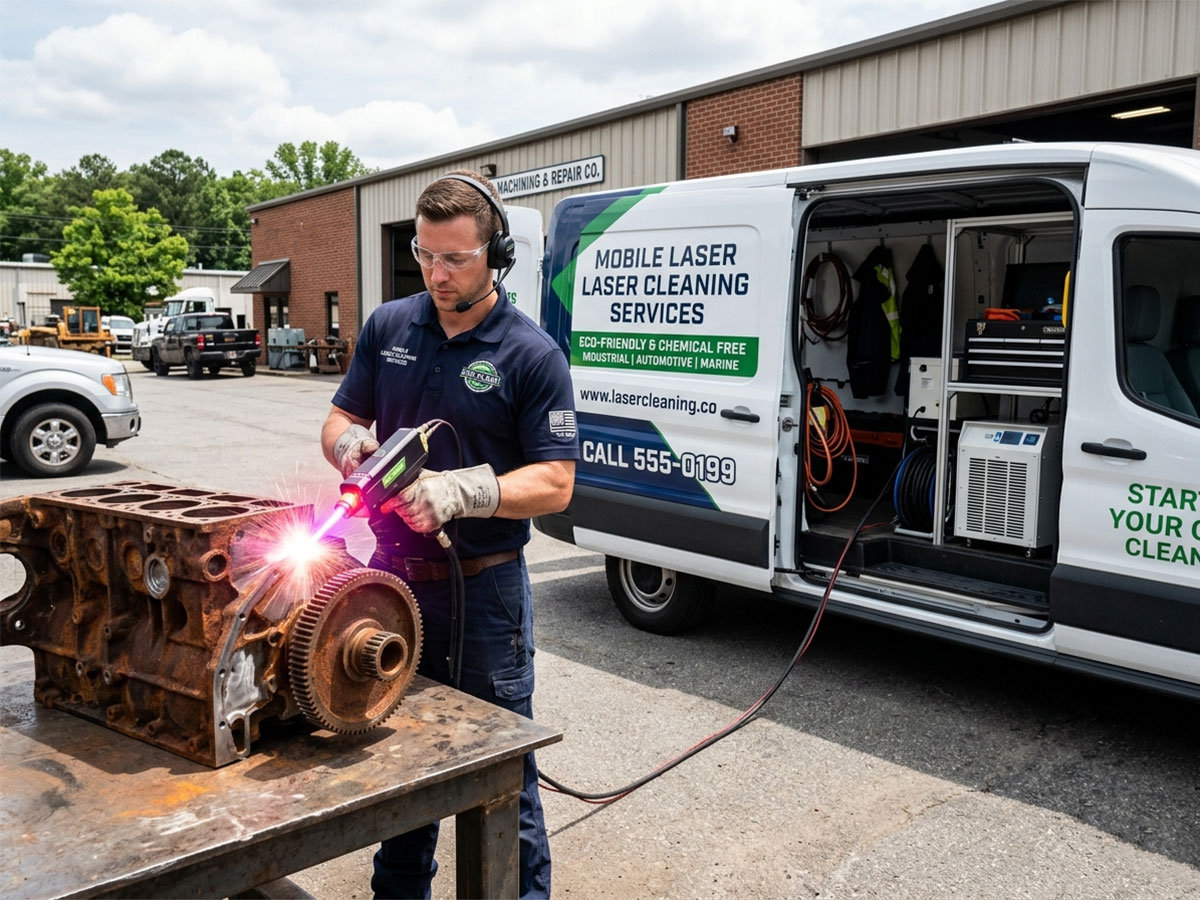
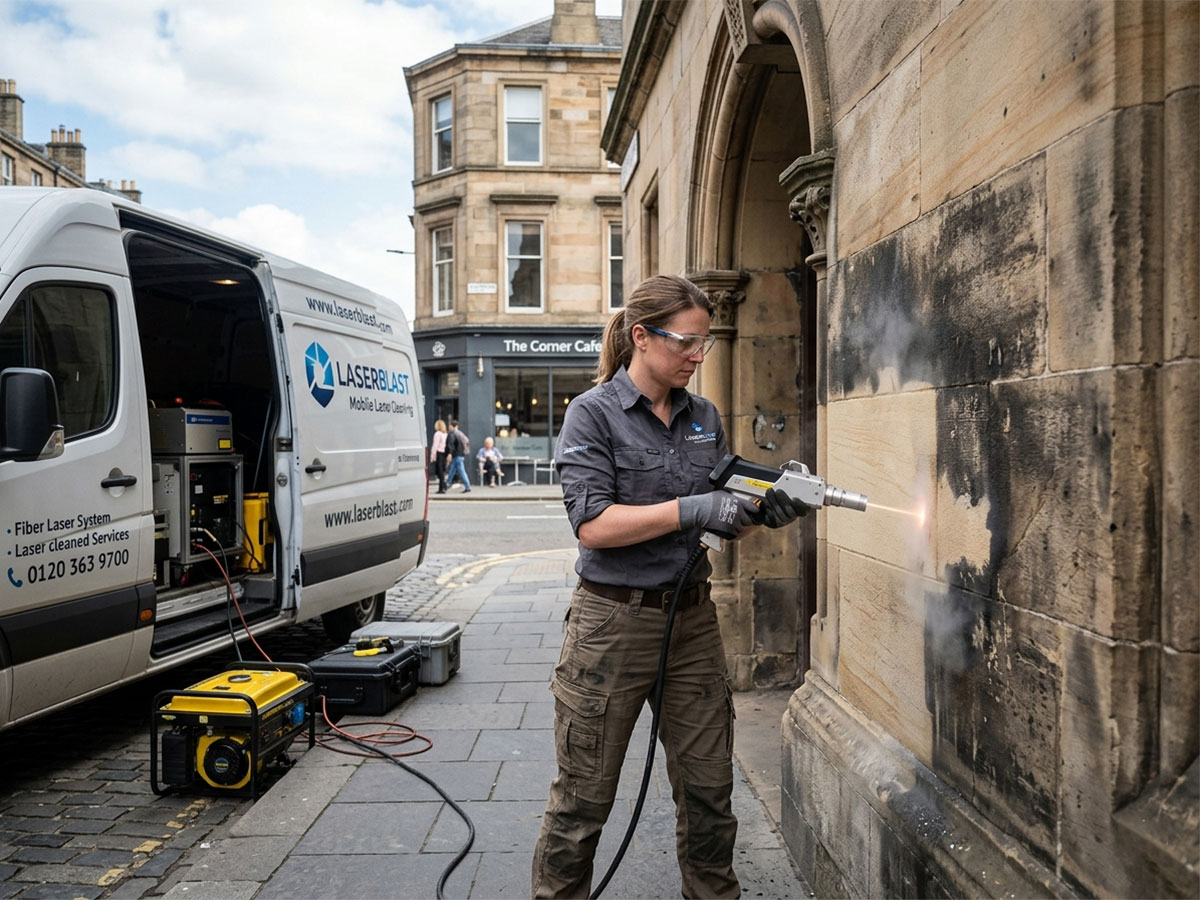
El modelo de negocio es sencillo: usted lleva un sistema portátil de limpieza láser a las instalaciones del cliente, limpia la superficie según las especificaciones y factura por hora o por proyecto. Sin gastos generales de taller. Sin transporte de materiales. Sin permisos para la eliminación de residuos.
Lo que usted aporta al lugar de trabajo
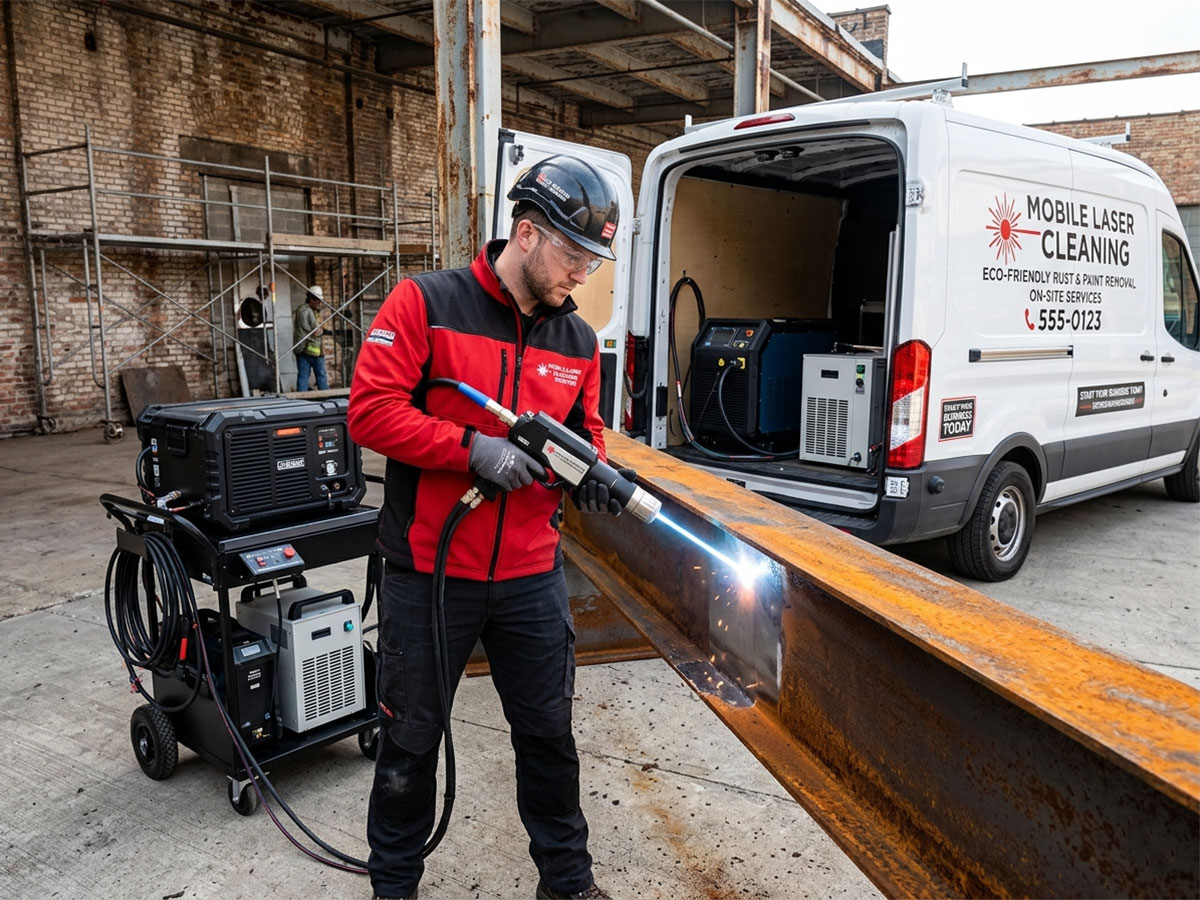
• Unidad portátil de limpieza láser de fibra (de 15 a 50 kg según el nivel de potencia).
• Cabezal de limpieza manual con ancho de haz ajustable.
• Gafas de seguridad láser (OD5+ a 1,064 nm) para el operador y cualquier trabajador cercano.
• Generador pequeño o acceso al cliente 220V fuente de alimentación.
• Vehículo de servicio: furgoneta, SUV con zona de carga o vehículo montado sobre remolque.
Lo que dejas atrás
Nada. Ese es el principal atractivo. No hay residuos de abrasivo esparcidos por el suelo. No hay residuos químicos. No hay desechos contaminados que requieran una eliminación especial. El material eliminado se vaporiza en micropartículas que son capturadas por el sistema de extracción integrado de la máquina o por un extractor de humos portátil. Los clientes pagan un precio superior precisamente porque la limpieza láser deja sus instalaciones más limpias de lo que las encontró.
Opciones de equipo: Portátil vs. Mochila vs. Fijo
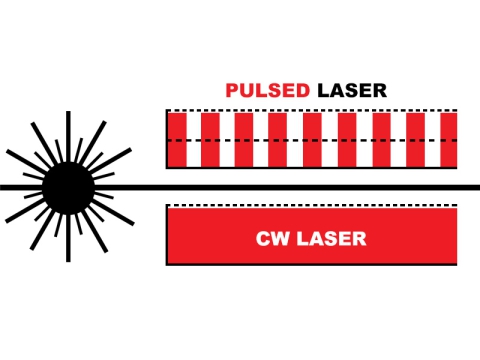
Elegir el equipo adecuado depende de sus clientes objetivo y de los tipos de trabajos que planea realizar. Comprender las diferencias entre láser pulsado frente a láser de onda continua La tecnología es la primera decisión, ya que determina la precisión de la limpieza, la velocidad y la seguridad de los materiales.
| Measurement | Pulsador portátil | Mochila pulsante | CW portátil | Sistema estacionario |
|---|---|---|---|---|
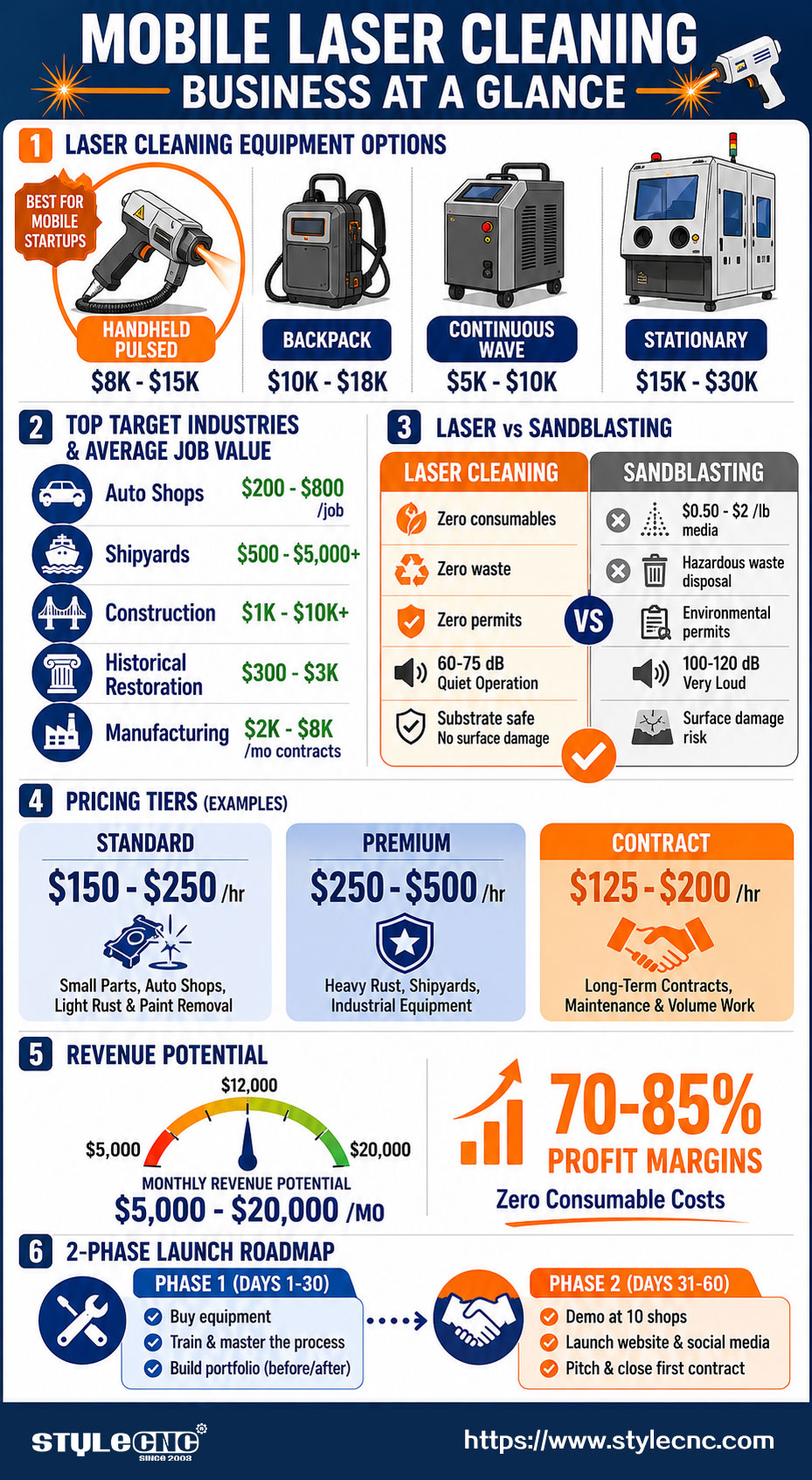
| Rango de Precio: | $ 8,000-$ 15,000 | $ 10,000-$ 18,000 | $ 5,000-$ 10,000 | $15,000–$30,000+ |
| Potencia | 100-300W | 100-200W | 1,000-2,000W | 200-1,000W |
| Peso | 15-30 kg | 10-18 kg | 30-50 kg | 50-200 kg |
| Movilidad | Alto (furgoneta/SUV) | Muy alto (para transportar por una sola persona) | Moderado (carro/furgoneta) | Bajo (ubicación fija) |
| Mejores aplicaciones | Óxido, pintura, óxidos en superficies planas/curvas | Acceso restringido, trabajo de campo, emplazamientos remotos | Óxido intenso, recubrimientos gruesos, desprendimiento rápido. | Limpieza de producción, limpieza de moldes |
| Seguridad del sustrato | Excelente (sin daños por calor) | Excelente | Moderado (aporte de calor en metales delgados) | Excelente |
| Consumibles | Cero | Cero | Cero | Cero |
| Mejor para móviles | Caballo de batalla principal | Trabajos remotos/confinados | Contratos industriales pesados | Servicio complementario basado en la tienda |
Para la mayoría de los operadores móviles que están comenzando, un máquina de limpieza por láser pulsado en los 100 a 300W Esta gama ofrece la mejor combinación de portabilidad, seguridad para el sustrato y precisión de limpieza. Los sistemas pulsados evitan la acumulación de calor que puede deformar metales delgados, lo que los hace seguros para paneles de automóviles, piezas de precisión y objetos históricos.
Los operadores que necesitan la máxima movilidad para lugares de trabajo remotos, andamios o espacios confinados deberían considerar una limpiador láser de mochila Esto deja ambas manos libres y elimina la necesidad de colocar un carro o una máquina cerca de la superficie de trabajo.
Sectores objetivo y tipos de clientes
Talleres mecánicos y talleres de restauración
La restauración de coches clásicos requiere una eliminación precisa del óxido sin dañar la chapa original. Los talleres de carrocería necesitan superficies metálicas limpias y sin óxido antes de aplicar la imprimación. La limpieza láser ofrece ambas ventajas sin deformar los paneles ni dañar el metal.
• Trabajo promedio: $200–$800 por vehículo (limpieza parcial o completa del chasis).
• Potencial de recompra: los talleres de restauración envían de 2 a 5 vehículos al mes.
Astilleros y mantenimiento naval
La limpieza del casco, la restauración de los herrajes de cubierta y la preparación de soldaduras en embarcaciones requieren un tratamiento superficial sin introducir material abrasivo en los cursos de agua. Las normativas medioambientales restringen cada vez más el arenado cerca del agua, lo que genera una demanda de limpieza láser impulsada por dichas normativas.
• Trabajo promedio: $500 y 5,000 dólares o más por embarcación, dependiendo del alcance.
• Ventaja competitiva: no se requieren permisos ambientales para la limpieza láser, en comparación con los extensos permisos necesarios para el arenado cerca del agua.
Contratistas de construcción e infraestructura
Los equipos de mantenimiento de puentes, los contratistas de estructuras de acero y los renovadores de edificios necesitan eliminar el óxido y preparar la superficie antes de aplicar recubrimientos protectores. La limpieza láser funciona en altura, en espacios confinados y en geometrías complejas sin necesidad de desmontar andamios.
• Trabajo promedio: $110,000 y más de 000 dólares para proyectos de puentes y estructuras.
• Los contratos gubernamentales y municipales suelen especificar métodos de limpieza no abrasivos, lo que convierte a la limpieza láser en la opción que cumple con la normativa.
Restauración y conservación histórica
Los museos, las sociedades históricas y las empresas de conservación necesitan una limpieza delicada de objetos de piedra, metal y madera que evite la pérdida de material. Los parámetros de la limpieza láser se pueden ajustar para eliminar los contaminantes superficiales, preservando al mismo tiempo la pátina y los acabados originales.
• Trabajo promedio: $300 y 3,000 dólares, dependiendo del tamaño y la sensibilidad del artefacto.
• Precios premium: los clientes históricos pagan 30 a 50% Más que clientes industriales, por la precisión y la garantía no destructiva.
Fabricación y limpieza de moldes
La limpieza de moldes de inyección, la preparación de soldaduras en líneas de producción y la preparación de superficies previas al recubrimiento son servicios recurrentes de alto valor. máquina de decapado de pintura láser Se utiliza en aplicaciones de eliminación de recubrimientos donde el uso de decapantes químicos está restringido o donde la preservación del sustrato es fundamental.
• Contrato promedio: $2000 y 8,000 dólares al mes para contratos de mantenimiento recurrentes.
Cómo calcular el precio de sus servicios de limpieza láser móvil
| Measurement | Tarifa estándar | Tarifa privilegiada | Tarifa de contrato |
|---|---|---|---|
| Pago por hora | $150–$250/hora | $250–$500/hora | $125–$200/hora |
| Tipo de contratación | Eliminación general de óxido, preparación de superficies. | Restauración de precisión, marina, histórica | Mantenimiento mensual recurrente |
| Carga mínima | $ 200 por visita | $ 300 por visita | Renunciado con contrato |
| Tarifa de viaje | Entre 50 y 100 dólares en un radio de 50 millas. | Entre 100 y 200 dólares a partir de las 50 millas. | Incluido en el contrato |
| Margen | 70-80% | 80-85% | 65-75% |
| Mejor cliente | Talleres de automóviles, pequeños talleres de fabricación | Astilleros, museos, gobierno | Fabricantes, operadores de flotas |
Cobra siempre un mínimo por visita para cubrir el tiempo de desplazamiento y montaje. $2El mínimo de 00 garantiza que no pierda dinero en trabajos pequeños. Para proyectos más grandes, cambie a precios por pie cuadrado (de $2 a $8/pie cuadrado dependiendo del nivel de contaminación) cuando produce un total más alto que la facturación por hora.
Los contratos de mantenimiento son el modelo de precios más valioso. Ofrezca limpieza mensual o trimestral a un precio de 15 a 20% Descuento sobre las tarifas únicas a cambio de un compromiso de 6 a 12 meses. Los contratos estabilizan el flujo de caja y reducen los costos de captación de clientes.
Desglose de los costos de puesta en marcha
| Categoría de Gastos | Presupuesto de entrada ($8–$15) | Profesional (entre 15 y 30 dólares) |
|---|---|---|
| Máquina de limpieza láser | $ 5,000-$ 10,000 | $ 10,000-$ 22,000 |
| Equipo de seguridad (gafas, señalización, barreras) | $ 200-$ 500 | $ 500-$ 1,000 |
| Extractor de humos portátil | $ 300-$ 800 | $ 800-$ 2,000 |
| Configuración del vehículo (estanterías, inversor de corriente) | $ 500-$ 1,500 | $ 1,500-$ 3,000 |
| Generador (si es necesario) | $ 500-$ 1,500 | $ 1,000-$ 2,500 |
| Seguros (responsabilidad civil + profesionales) | $500–$1,000/año | $1,000–$2,000/año |
| Marketing y sitio web | $ 200-$ 500 | $ 500-$ 1,500 |
| Registro de Empresas | $ 50-$ 200 | $ 100-$ 300 |
| Measurement | ||
| Total | $ 7,250-$ 16,000 | $ 15,400-$ 34,300 |
Explore toda la gama de máquinas de limpieza láser de fibra Para comparar los niveles de potencia, las opciones de portabilidad y los precios de todos los modelos antes de seleccionar su equipo.
Ventajas sobre los métodos de limpieza tradicionales
• Cero consumibles: no hay arena, productos químicos, hielo seco ni materiales abrasivos que comprar, transportar o desechar.
• Permisos de cero residuos: el arenado cerca de cursos de agua o en zonas urbanas requiere permisos medioambientales que la limpieza láser no necesita.
• Preservación del sustrato: la limpieza láser elimina los contaminantes sin eliminar el material base, lo cual es fundamental para paneles delgados y objetos históricos.
• Velocidad: los procesos de limpieza láser limpian de 1 a 15 pies cuadrados por hora, dependiendo de la contaminación y el nivel de potencia, de forma comparable al chorro de arena en óxido ligero y más rápida en trabajos de precisión.
• Portabilidad: una unidad portátil de 15 kg puede llevarse a cualquier lugar donde una persona pueda, incluidos espacios confinados, plataformas elevadas y el interior de tanques.
• Seguridad: sin exposición al polvo de sílice (una de las principales causas de enfermedades pulmonares ocupacionales en el arenado), sin riesgo de salpicaduras de productos químicos, sin proyección de material abrasivo.
• Ruido: la limpieza láser funciona a entre 60 y 75 dB, frente a los 100 a 120 dB del chorro de arena, lo que permite trabajar en entornos sensibles al ruido.
Errores comunes que cuestan dinero a los nuevos operadores
• Adquirir un láser de onda continua (CW) para trabajos de precisión donde se requiere un láser pulsado, lo que provoca daños por calor en metales delgados y la pérdida de la confianza del cliente.
• Ofrecer servicios con precios inferiores a los del arenado, en lugar de cobrar por la ventaja adicional (sin desperdicio, sin daños, sin permisos) que ofrece la limpieza láser.
• Omitir la capacitación en seguridad láser y la señalización adecuada, lo que genera riesgos de responsabilidad y viola las normas ANSI Z136.
• Centrarse en un solo sector en lugar de diversificar entre 3 o 4 tipos de clientes para estabilizar los ingresos a lo largo de los ciclos estacionales.
• No ofrecer contratos de mantenimiento, lo que significa empezar de cero cada mes en lugar de generar ingresos recurrentes.
• Descuidar la presencia en línea: la mayoría de los clientes buscan "eliminación de óxido con láser cerca de mí" antes de llamar, por lo que un sitio web básico con fotos del antes y el después es esencial.
• No contar con un seguro adecuado, especialmente si se trabaja en vehículos, embarcaciones o artefactos históricos propiedad del cliente.
Primeros pasos: Tu plan para los primeros 60 días.
¿Es nuevo en la tecnología de limpieza láser? Guía para principiantes sobre máquinas de limpieza láser Abarca los principios de funcionamiento, los requisitos de seguridad y la configuración de los materiales para que pueda ser productivo desde el primer día.
Días 1 a 30: Instalación
✔ Adquiera un sistema de limpieza láser pulsado (100 a 300W) y capacitación completa para el operador.
✔ Registra tu negocio, obtén un seguro de responsabilidad civil y abre una cuenta bancaria comercial.
✔ Crea un sitio web sencillo de una sola página con descripciones de los servicios, rangos de precios y un formulario de solicitud de presupuesto.
✔ Practica con materiales de muestra: acero oxidado, metal pintado, aluminio oxidado y superficies revestidas.
✔ Crea un portafolio de fotos de antes y después con al menos 10 ejemplos de limpiezas.
Días 31 a 60: Captación de clientes
✔ Visite 10 talleres de carrocería, 5 talleres de soldadura/fabricación y 3 proveedores de servicios náuticos con demostraciones de muestra.
✔ Ofrezca una demostración gratuita de 30 minutos en un equipo propiedad del cliente para mostrar los resultados de primera mano.
✔ Publica tus servicios en Google Business Profile, Thumbtack y directorios específicos de tu sector.
✔ Publica vídeos del antes y el después en Instagram, TikTok y YouTube semanalmente (los vídeos de limpieza láser tienen un gran éxito en las redes sociales).
✔ Propóngale a un contacto municipal o gubernamental sobre contratos de limpieza de puentes/infraestructuras.
✔ Propón un contrato de mantenimiento mensual a tu primer cliente recurrente.
Preguntas frecuentes
¿Cuánto puede ganar al mes un negocio móvil de limpieza láser?
La mayoría de los operadores facturan de 20 a 30 horas por semana en $150 hasta $300 por hora generar $12,000 hasta $36,000 en ingresos brutos mensuales. Después de los costos operativos (combustible, seguro, mantenimiento de vehículos), el ingreso neto generalmente se sitúa entre $5, 000 y $20,000 por mes dependiendo de la utilización y el precio.
¿Cuál es la diferencia entre los limpiadores láser de onda pulsada y de onda continua?
Los láseres pulsados emiten energía en ráfagas cortas y de alta intensidad que eliminan los contaminantes sin calentar el sustrato. Son más seguros para metales delgados, piezas de precisión y objetos históricos. Los láseres de onda continua emiten energía constante y limpian más rápido, pero generan más calor, por lo que son más adecuados para la eliminación de óxido industrial intenso en superficies gruesas y resistentes al calor.
¿Necesito certificaciones o licencias especiales para operar un negocio de limpieza láser?
No se requiere licencia federal para operar un negocio de limpieza láser en los EE. UU. Sin embargo, las normas ANSI Z136.1 exigen que cualquier instalación o lugar de trabajo que utilice un láser de Clase 4 designe un Oficial de Seguridad Láser (LSO). Para una operación unipersonal, esa persona eres tú. Los cursos de capacitación para LSO tienen un costo $300 hasta $600 y están disponibles en el Laser Institute of America.
¿Es segura la limpieza láser para todo tipo de superficies metálicas?
La limpieza con láser pulsado es segura para prácticamente todos los metales, incluidos el acero, el acero inoxidable, el aluminio, el cobre, el latón y el hierro fundido. También es eficaz en piedra, hormigón y madera para aplicaciones de restauración. La única limitación son las superficies altamente reflectantes en ciertos ángulos, que pueden desviar el haz. Una formación adecuada y una gestión correcta del haz eliminan este riesgo.
¿Cómo se compara el coste por trabajo de la limpieza láser con el del chorro de arena?
La limpieza láser tiene una tarifa por hora más alta (150 dólares a $500) en comparación con el arenado ($75 a $150). Sin embargo, la limpieza láser elimina los costos de los medios ($0.50 a $2/libra de arena), mano de obra de limpieza (de 1 a 3 horas por trabajo), tarifas de eliminación de residuos ($200 a $1(000 por contenedor), y los costos de permisos. En términos de costo total, la limpieza láser a menudo iguala o supera al chorro de arena, a la vez que ofrece un resultado más limpio y preciso.
¿Puedo gestionar este negocio a tiempo parcial como actividad complementaria?
Sí. El equipo es portátil y no requiere un taller fijo. Muchos operarios comienzan con 2 o 3 trabajos por semana, manteniendo su empleo a tiempo completo. Los fines de semana y las noches son ideales para talleres de restauración de automóviles y pequeños talleres de fabricación. Una vez que la facturación semanal supere de forma constante los ingresos de su empleo, podrá dedicarse a tiempo completo.
¿Qué gastos recurrentes debo presupuestar después de la compra inicial del equipo?
La limpieza láser tiene los costos operativos más bajos de cualquier método de limpieza de superficies. Costos de electricidad $1 a $3 por hora de operación. Corre el seguro $500 hasta $2000 al año. El combustible y el mantenimiento del vehículo dependen de la distancia recorrida. No hay costos de consumibles, ni recargas de productos químicos, ni tarifas de eliminación de residuos. Los costos operativos mensuales totales para un operador móvil suelen oscilar entre $300 hasta $800 sin incluir los pagos del vehículo.
¿Con qué nivel de potencia debería empezar un negocio de limpieza móvil?
Un 100 a 200W mangos láser pulsado 80% de trabajos de servicio móvil que incluyen óxido automotriz, limpieza industrial ligera y proyectos de restauración. Para contratos industriales pesados que involucren óxido grueso o grandes áreas de superficie, pase a 300W o superior. Revise la gama completa de máquinas de eliminación de óxido por láser para ajustar el nivel de potencia a la combinación de clientes objetivo.
¿Listo para lanzar tu negocio de limpieza láser móvil?
STYLECNC fabrica sistemas de limpieza láser de fibra portátiles, de mochila e industriales 100W a 2,000W Para operadores de servicios móviles y equipos de mantenimiento industrial en más de 180 países. Cada máquina incluye soporte técnico de por vida, capacitación para el operador y un equipo de ingeniería de posventa especializado.
Explore el completo máquina de limpieza láser de fibra colección o comparación limpiadores láser de mochila Para una máxima movilidad en el campo. Solicite un presupuesto gratuito en STYLECNC