¿Qué es el aluminio billet?
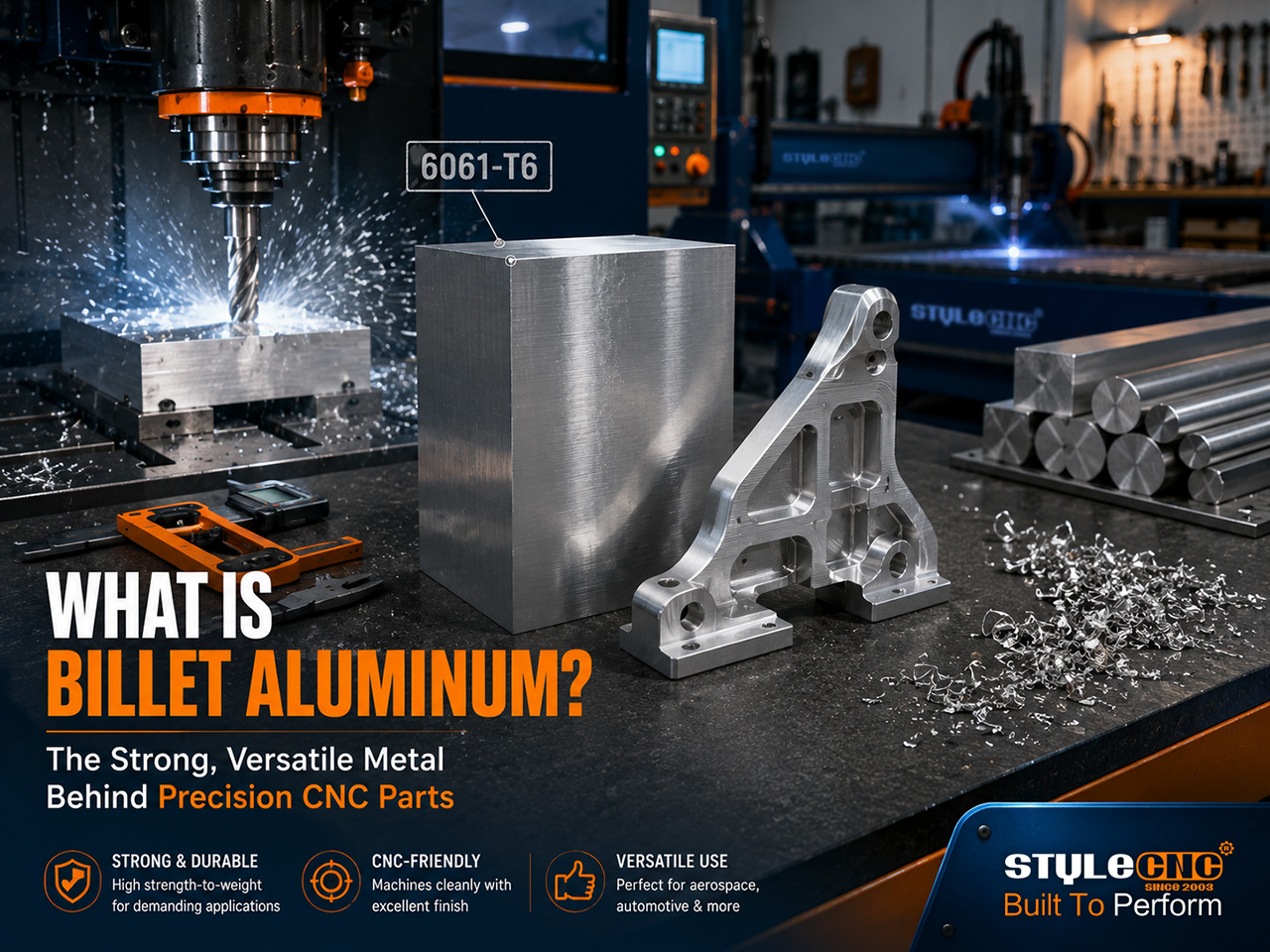
El aluminio en bruto es un bloque o barra sólida de aluminio forjado, extruido o laminado a partir de un lingote fundido y luego cortado a la medida. Las piezas denominadas en bruto se mecanizan a partir de este material sólido, en lugar de verterse en un molde (fundición) o forjarse (moldeo). El proceso de mecanizado en bruto proporciona una estructura granular uniforme y un comportamiento predecible durante el mecanizado.
En rigor, el término "lingote" describe una materia prima, no un material mágico. El aluminio se obtiene a partir de metal fundido vertido en grandes lingotes. Estos lingotes se extruyen o laminan en caliente para formar barras, discos y placas, un proceso que comprime el metal, refina su estructura granular y elimina la mayoría de los poros internos que deja la fundición. Al cortar esa barra forjada en bloques del tamaño de una pieza de trabajo, se obtienen los lingotes.
Cuando un fabricante dice que una pieza es de palanquilla, significa que fue mecanizada a partir de ese bloque sólido forjado. Todo el material que no forma parte de la pieza se elimina en forma de virutas. Este es el proceso de fabricación sustractiva en su forma más pura, y es la razón por la que las piezas de palanquilla gozan de una reputación de calidad y un precio superior: el proceso desperdicia material, pero produce piezas con una estructura interna uniforme, densa y sin poros.
La reputación de calidad que rodea a los bloques mecanizados es, en su mayor parte, merecida, pero a menudo exagerada. Una pieza fundida bien diseñada puede superar en rendimiento a una pieza mecanizada mal diseñada. Lo que sí garantizan los bloques mecanizados es consistencia: ausencia de sorpresas porosas, ausencia de huecos ocultos, resistencia predecible en todas las direcciones que permite la extrusión y estabilidad dimensional durante el mecanizado.
Aluminio mecanizado vs. aluminio fundido vs. aluminio forjado: las diferencias reales
Tres procesos de producción transforman el aluminio en bruto en piezas acabadas, y cada uno deja una huella distintiva en el metal. La siguiente tabla compara estos procesos según los factores clave para el rendimiento y el mecanizado de las piezas.
| Factor | Lingote (mecanizado) | Reparto/Emisión | Falsificado |
|---|---|---|---|
| Como está hecho | Mecanizado a partir de barra o placa maciza forjada | Metal fundido vertido en un molde | La pieza en bruto se calienta y se martilla o prensa para darle forma. |
| Estructura interna | Uniforme, denso, sin huecos | Posible porosidad y huecos de contracción | Más denso; los flujos de grano siguen la forma de la pieza. |
| Solidez | Alto y consistente | El más bajo de los tres; varía según la calidad del molde. | Máxima resistencia, especialmente a la fatiga. |
| Libertad de diseño | Limitado por el acceso a la herramienta | Máximo; formas internas complejas posibles | Limitado; formas sencillas y robustas |
| Costo de herramienta | Ninguno (solo instalación) | Alto (costo del molde) amortizado sobre el volumen | El costo más alto (del troquel) se aplica a grandes volúmenes. |
| Mejor volumen | De 1 a cientos | Cientos a millones | Miles a millones |
| Piezas típicas | Prototipos, soportes personalizados, piezas de alto rendimiento | Bloques de motor, carcasas, ruedas (fundidas) | Brazos de suspensión, accesorios de aeronaves, cigüeñales |
| Proceso de acabado superficial | Acabado mecanizado, Ra 1.6 o superior | Tal como se fundió; mecanizado donde fuese necesario | Piel forjada; mecanizada en las interfaces. |
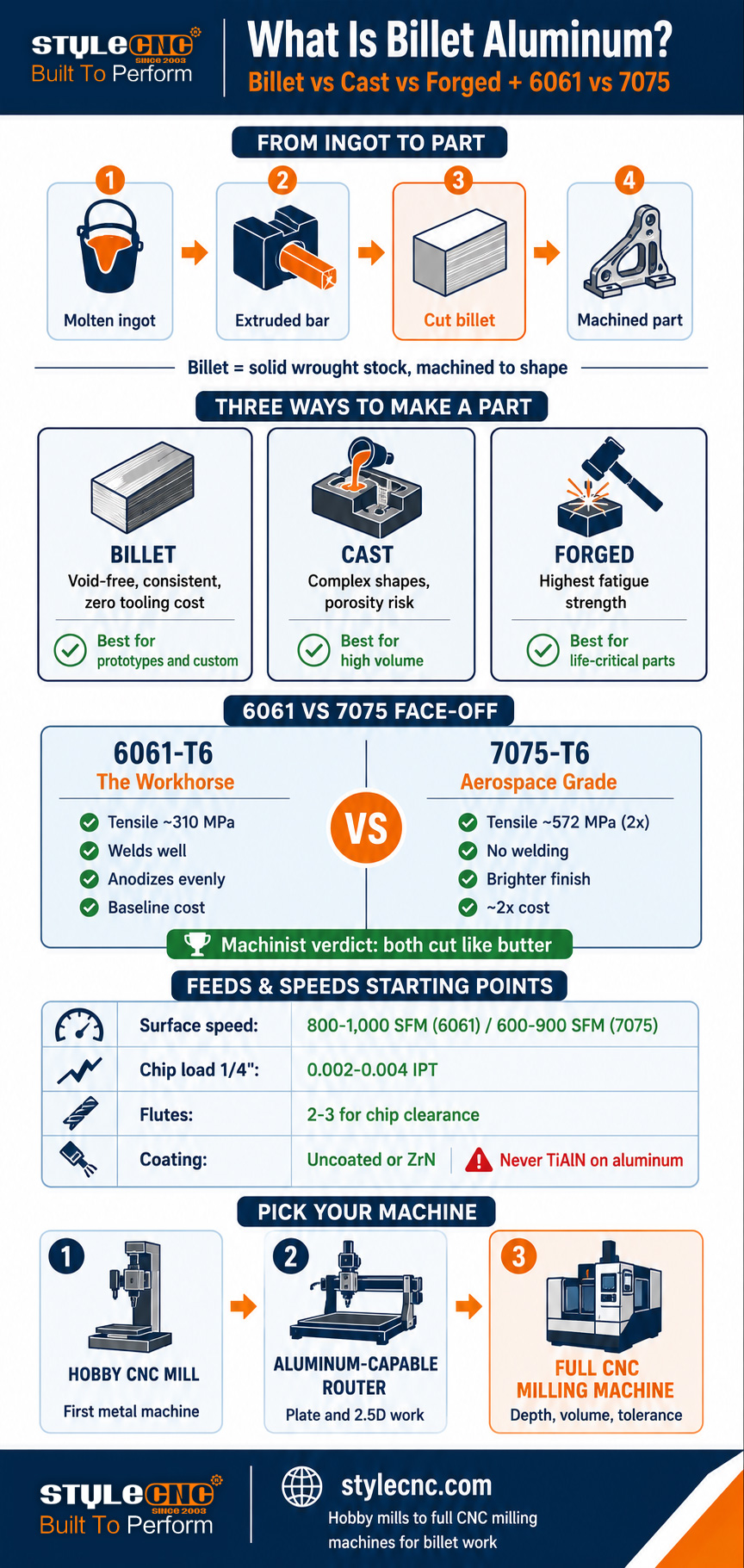
La regla práctica para tomar decisiones es la siguiente: la fundición gana en grandes volúmenes, donde el costo del molde se amortiza y la geometría compleja es importante. La forja gana cuando la resistencia a la fatiga es crítica para la vida útil. El mecanizado a partir de lingotes gana para prototipos, trabajos personalizados de bajo volumen y cualquier pieza donde un aficionado o taller necesite máxima resistencia de inmediato sin inversión en herramientas. Este último caso es precisamente donde se encuentran las fresadoras CNC y las fresadoras para aluminio.
6061 vs 7075: Las 2 calificaciones que importan
Si acude a cualquier proveedor de metales, dos aleaciones forjadas dominan los estantes de lingotes: la 6061 y la 7075. Según datos de la Asociación del Aluminio, las series 6000 y 7000 son las más utilizadas en el mecanizado CNC, y para la mayoría de los talleres la elección se reduce a estas dos.
| Propiedad | 6061-T6 (el caballo de batalla) | 7075-T6 (grado aeroespacial) |
|---|---|---|
| Resistencia a la tracción | ~310 MPa (45 ksi) | ~572 MPa (83 ksi), aproximadamente el doble |
| Dureza (Brinell) | ~ 95 | ~ 150 |
| Resistencia a la corrosión | Excelente; anodiza de manera uniforme. | Regular; generalmente anodizado o recubierto para protección. |
| soldabilidad | Buen manejo de procesos estándar | Malo; no se recomienda soldar. |
| maquinabilidad | Muy bueno; patatas fritas ligeramente gomosas. | Muy bueno; más duro, las virutas se rompen más limpiamente. |
| Acabado de la superficie | Bueno; color de anodizado uniforme | Acabado mecanizado más brillante; el color del anodizado varía. |
| Coste relativo | Base | Aproximadamente el doble por libra (cotizaciones reales: ~$38 frente a ~$101 por barra equivalente) |
| Ideal para | Soportes, fijaciones, carcasas, piezas en general | Componentes estructurales sometidos a altas tensiones, industria aeroespacial, competición. |
Lo que no se menciona en las especificaciones técnicas es la similitud en el rendimiento de ambos materiales en la máquina. Los miembros de Practical Machinist que los mecanizan a diario informan que, utilizando programas y herramientas idénticas, el 7075 ofrece un acabado notablemente más brillante y facilita la rotura de virutas, aunque el desgaste de los filos de carburo es ligeramente mayor. Un miembro resumió el consenso de la comunidad: ambos cortan como la mantequilla. Los usuarios del foro Hobby-Machinist coinciden: con las mismas velocidades de avance que el 6061, no hay que temer al 7075.
Los factores clave para tomar una decisión son el costo y la aplicación, no la maquinabilidad. Pague el doble por el 7075 cuando la pieza realmente necesite resistencia: soportes de carga, componentes de suspensión, fijaciones sometidas a altas tensiones. Use 6061 para todo lo demás y obtenga, como beneficio adicional, una mejor uniformidad en el anodizado y una mayor soldabilidad.
¿Qué significa T6? Los temperamentos explicados en lenguaje sencillo.
Las letras que siguen al número de aleación describen el temple, el estado de tratamiento térmico que determina la resistencia final. Para los compradores de lingotes, tres designaciones abarcan prácticamente todo lo que hay en el estante.
✓ T6Tratamiento térmico de solución y envejecimiento artificial. Temple estándar de máxima resistencia para los aceros 6061 y 7075. Si en la descripción solo se indica 6061 o 7075 sin especificar el temple, se debe asumir que es T6, pero confirmarlo antes de comprarlo para trabajos estructurales.
✓ T651T6 con un estiramiento controlado que alivia la tensión interna. Importancia para la chapa: La chapa T651 se mantiene más plana durante el mecanizado porque se eliminan las tensiones residuales que provocan la deformación. Merece la pena el pequeño coste adicional para piezas con grandes cavidades.
✓ O (recocido)Estado blando, recocido. Fácil de doblar, muy difícil de mecanizar (extremadamente gomoso) y débil. Evítelo para piezas mecanizadas a menos que planee darles forma primero y luego aplicarles un tratamiento térmico.
Es fundamental destacar el punto de alivio de tensiones para quienes mecanizan chapa gruesa. Al mecanizar cavidades profundas en material sin alivio de tensiones, se liberan tensiones internas y la pieza puede deformarse visiblemente al desprenderse material. La chapa T651 se fabrica específicamente para evitar esto. Para piezas delgadas y soportes pequeños, la barra T6 estándar es suficiente.
Mecanizado de aluminio en bruto: Conceptos básicos de avances y velocidades
El aluminio es el metal más fácil de mecanizar, por lo que es ideal para quienes se inician en el mecanizado tras trabajar con madera y plásticos. Los valores que se muestran a continuación son puntos de partida consensuados, basados en tablas de corte estándar de la industria y en la práctica de foros de maquinistas. Considérelos como rangos iniciales y luego ajústelos según el sonido del corte.
| Parámetro | Punto de partida 6061-T6 | Punto de partida 7075-T6 |
|---|---|---|
| Velocidad superficial (carburo) | Desbaste de 800 a 1,000 SFM | 600 a 900 SFM (10 a 20% inferior) |
| Carga de chips, 1/4 fresa de extremo de pulgadas | 0.002 a 0.004 IPT | 0.002 a 0.004 IPT (similar) |
| Carga de chips, 1/2 fresa de extremo de pulgadas | 0.003 a 0.006 IPT | 0.003 a 0.006 IPT (similar) |
| Conteo de flautas | 2 o 3 ranuras para evacuar las virutas | De 2 o 3 flautas; las virutas se rompen con mayor facilidad. |
| Recubrimiento de herramientas | Sin recubrimiento o ZrN (nunca TiAlN) | Sin recubrimiento o ZrN (nunca TiAlN) |
| Refrigerante / lubricación | Niebla o inundación; previene la acumulación de agua en el borde. | Lo mismo; la gestión del calor importa un poco más. |
Tres reglas son más importantes que cualquier tabla. Primero, la carga de viruta es fundamental: si la viruta es demasiado ligera, la herramienta roza en lugar de cortar, generando calor y soldando aluminio al filo (relleno de filo, el principal causante de un mal acabado en aluminio). Segundo, elimine las virutas del corte: volver a cortar las virutas arruina los acabados y rompe las herramientas, por lo que las fresas de 2 y 3 filos con gargantas grandes son las más utilizadas para trabajar con aluminio. Tercero, nunca utilice herramientas con recubrimiento de TiAlN en aluminio: el recubrimiento contiene aluminio y se adhiere químicamente a la pieza de trabajo.
Un ejemplo práctico para máquinas de modelismo
Equipo práctico: una fresadora de aficionados o una fresadora capaz de trabajar con aluminio con un husillo de 4,200 RPM y un 1/2 Fresa de carburo de 3 filos de 6061. Un miembro de Hobby-Machinist que utiliza exactamente esta configuración reporta de 30 a 40 IPM con una carga de viruta de aproximadamente 0.005 pulgadas por diente y 3 HP de potencia disponible. Esa es la característica del mecanizado de aluminio en máquinas modestas: RPM moderadas, cargas de viruta adecuadas y una sujeción rígida de la pieza superan las velocidades superficiales de los grandes talleres.
Las fresadoras de altas RPM cambian las reglas del juego. Un husillo de fresadora de 10,000 a 24,000 RPM no puede reducir la velocidad lo suficiente para fresas grandes, por lo que el trabajo con fresadora de aluminio favorece las fresas de extremo pequeñas de una y dos ranuras (1/8 a 1/4 pulgadas) funcionan a alta velocidad con una alimentación agresiva para mantener la carga de virutas. Las brocas de aluminio de una sola ranura existen precisamente para esto: una ranura grande elimina las virutas a velocidades de fresado donde las herramientas de múltiples ranuras se atascan.
¿Qué máquina necesitas para trabajar con aluminio lingoteado?
El mecanizado de aluminio en bloque está al alcance de muchas más máquinas de las que los principiantes creen. Lo que se requiere es rigidez y control de virutas, no potencia bruta. Tres clases de máquinas cubren todo el espectro, desde el aficionado hasta el profesional.
Fresadoras CNC de escritorio y para aficionadosDiseñado específicamente para metal, con bastidores de hierro rígidos y husillos de alto par y bajas RPM que se adaptan a fresas más grandes. Fresadora CNC para metal, ideal para aficionados. y fresadora CNC pequeña de escritorio Esta clase maneja soportes, carcasas y piezas pequeñas de aluminio 6061 y 7075. Es la primera máquina metalúrgica por excelencia.
Fresadoras CNC aptas para aluminioLas fresadoras de pórtico con bastidores rígidos, husillos adecuados y lubricación por niebla cortan bien el aluminio en bloque utilizando el método de fresa pequeña y altas RPM. Guía de soluciones para fresadoras CNC de aluminio cubre los requisitos de configuración y el Fresadora CNC de aluminio con sistema ATC de disco Representa la etapa final de producción donde los cambios de herramientas y los volúmenes mayores son importantes. Las fresadoras son ideales para el trabajo con chapa: piezas planas de palanquilla, paneles y soportes 2.5D.
Fresadoras CNC completas. Para cortes más profundos, temple más duro, volúmenes de producción y piezas que necesitan múltiples configuraciones, el Catálogo de fresadoras CNC Abarca desde fresadoras automáticas de metal hasta plataformas de grado molde. El salto cualitativo proporciona rigidez, lo que se traduce directamente en una eliminación de material más rápida y mejores tolerancias en el trabajo con lingotes. La gama más amplia Catálogo de máquinas CNC para metal Cubre opciones adyacentes para talleres que combinan aluminio con acero, latón y cobre.
Glosario: Términos de aluminio mecanizado
Utilice esta referencia al comprar acciones, leer hilos de foros o comparar listados de materiales.
| Término | Definición |
|---|---|
| Billete | Bloque o barra maciza de aluminio forjado, cortada a partir de material extruido o laminado, lista para el mecanizado. |
| Forjado | Aluminio que ha sido trabajado mecánicamente (extruido, laminado) después de la fundición, refinando así su estructura granular. |
| Lingote | El gran bloque de aluminio fundido a partir del cual se elaboran los productos forjados. |
| Templar | Designación del estado de tratamiento térmico (T6, T651, O) que determina la resistencia y dureza finales de la aleación. |
| T651 | Tratamiento térmico T6 más estiramiento controlado para aliviar tensiones; mantiene la placa gruesa plana durante el mecanizado. |
| Borde de aportación (BUE) | El aluminio se suelda al filo de corte debido al calor y la fricción; esta es la principal causa de los malos acabados. |
| Carga del chip (IPT) | Cada diente de corte elimina varias pulgadas de material por revolución; la velocidad de avance y de corte del núcleo es variable. |
| SFM | Pies superficiales por minuto; la velocidad del filo de corte a través del material. |
| Gomosidad | Tendencia del aluminio blando (especialmente el 6061 y el material recocido) a deformarse en lugar de cortarse limpiamente. |
| Porosidad | Huecos internos debidos a gases atrapados en el aluminio fundido; ausentes en las piezas de aluminio forjadas correctamente. |
Preguntas frecuentes
¿Es el aluminio mecanizado en bloque más resistente que el aluminio fundido?
En general, sí, para la misma familia de aleaciones. El proceso de forjado que produce el material en bruto elimina la porosidad y los huecos que pueden quedar en la fundición, lo que confiere a las piezas en bruto una resistencia más uniforme. El aluminio forjado supera a ambos en resistencia a la fatiga, ya que el forjado alinea el flujo del grano con la forma de la pieza. Cabe aclarar que una pieza fundida bien diseñada puede tener un mejor rendimiento que una pieza en bruto mal diseñada, por lo que el material en bruto garantiza la uniformidad, pero no la resistencia.
¿Es el 7075 más difícil de mecanizar que el 6061?
Apenas, según los maquinistas que trabajan con ambos materiales a diario. Los miembros del foro Practical Machinist informan que utilizan programas y herramientas idénticas en ambas aleaciones, con la diferencia de que la 7075 desgasta los filos de carburo un poco más rápido, rompe las virutas con mayor facilidad y deja un acabado superficial más brillante. Las tablas de corte actuales de la industria sitúan las velocidades de corte superficial de la 7075 entre un 10 y un 20 por ciento por debajo de la 6061 (de 600 a 900 SFM frente a 800 a 1,000 SFM de desbaste con carburo) con cargas de viruta similares. Ninguna de las dos aleaciones debería intimidar a un aficionado.
¿Por qué el 7075 es mucho más caro que el 6061?
Aleación a base de zinc, mayor control de producción y demanda aeroespacial. Los precios reales de los foros de compra de Practical Machinist muestran claramente la diferencia: barras comparables cotizadas a unos 38 $para 6061-T6 frente a 101 $para 7075-T6, cerca del sobreprecio de más del doble que se suele mencionar. El coste adicional proporciona aproximadamente el doble de resistencia a la tracción (alrededor de 572 MPa frente a 310 MPa), lo que solo resulta rentable en aplicaciones que realmente soportan cargas.
¿Puede una fresadora CNC cortar realmente bloques de aluminio?
Sí, con el enfoque correcto. Las fresadoras de bastidor rígido con husillos adecuados cortan placas de aluminio macizo de forma rutinaria utilizando fresas de carburo de una o dos ranuras pequeñas (1/8 a 1/4 (pulgada) funciona a altas RPM con avance agresivo para mantener la carga de viruta, además de lubricación por niebla para evitar la acumulación de material en el filo. Lo que las fresadoras no pueden hacer bien es el desbaste profundo y pesado con fresas grandes, que es donde entran en juego las fresadoras CNC rígidas. Los soportes planos, los paneles y las piezas de palanquilla 2.5D son territorio exclusivo de las fresadoras.
¿Qué significa T6 en 6061-T6?
T6 es la designación de temple: tratamiento térmico de solución y envejecimiento artificial para alcanzar su máxima resistencia. Es la condición estándar para los lingotes de 6061 y 7075. El tratamiento T651 añade un estiramiento controlado que alivia la tensión interna, lo que mantiene la placa gruesa plana al mecanizar cavidades profundas. El material recocido (temperamento O) es blando, difícil de mecanizar y débil, por lo que debe evitarse para piezas mecanizadas.
¿Con qué avances y velocidades debería empezar un principiante en el mecanizado de aluminio en bloque?
Con herramientas de carburo en 6061-T6: aproximadamente de 800 a 1,000 SFM de velocidad superficial, de 0.002 a 0.004 pulgadas de carga de viruta por diente en un 1/4 Fresa de extremo de una pulgada, 2 o 3 ranuras, sin recubrimiento o con recubrimiento de ZrN, y refrigerante por niebla o inundación. En una máquina de aficionado limitada a alrededor de 4,200 RPM con una 1/2 Fresa de 3 filos de una pulgada, según la práctica documentada en foros, funciona a 30-40 IPM con una carga de viruta de aproximadamente 0.005. Comience con precaución, escuche el corte y aumente el avance antes de aumentar la velocidad.
Lo más importante es...
El aluminio forjado es simplemente material laminado mecanizado para obtener piezas, y su reputación se debe a la consistencia de su estructura forjada: ausencia de porosidad en la fundición, resistencia predecible y facilidad de mecanizado. Para la mayoría de los trabajos, la aleación 6061-T6 es la opción ideal, mientras que la 7075-T6 se reserva para piezas que requieren el doble de resistencia, aunque a un precio mayor. Ambas aleaciones se mecanizan con la suficiente facilidad como para ser los metales adecuados para cualquier aficionado que quiera iniciarse en el mundo del modelado, más allá de la madera y el plástico.
La máquina importa más que el metal. Una rígida Fresadora CNC para aficionados o una configuración adecuada Router CNC apto para aluminio abre el trabajo de lingotes a cualquier taller, y el Catálogo completo de fresadoras CNC Cubre el paso adelante cuando el tamaño, la profundidad o el volumen de la pieza superan la clase de entrada. Contacte con el STYLECNC Contamos con un equipo que le ayudará a seleccionar la máquina adecuada para las piezas mecanizadas que desea fabricar.