Ask any machinist forum which digital caliper to buy and 2 answers dominate the thread within an hour. Buy the Mitutoyo, it will outlive you. Or: buy the Insize, it does the same job for a 3rd of the money. Both camps are right about something, and both leave something out. This guide lays out what each brand actually delivers, what the spec sheets and forum veterans agree on, how to avoid the counterfeit trap that catches Mitutoyo buyers, and which caliper fits which shop.
La respuesta corta
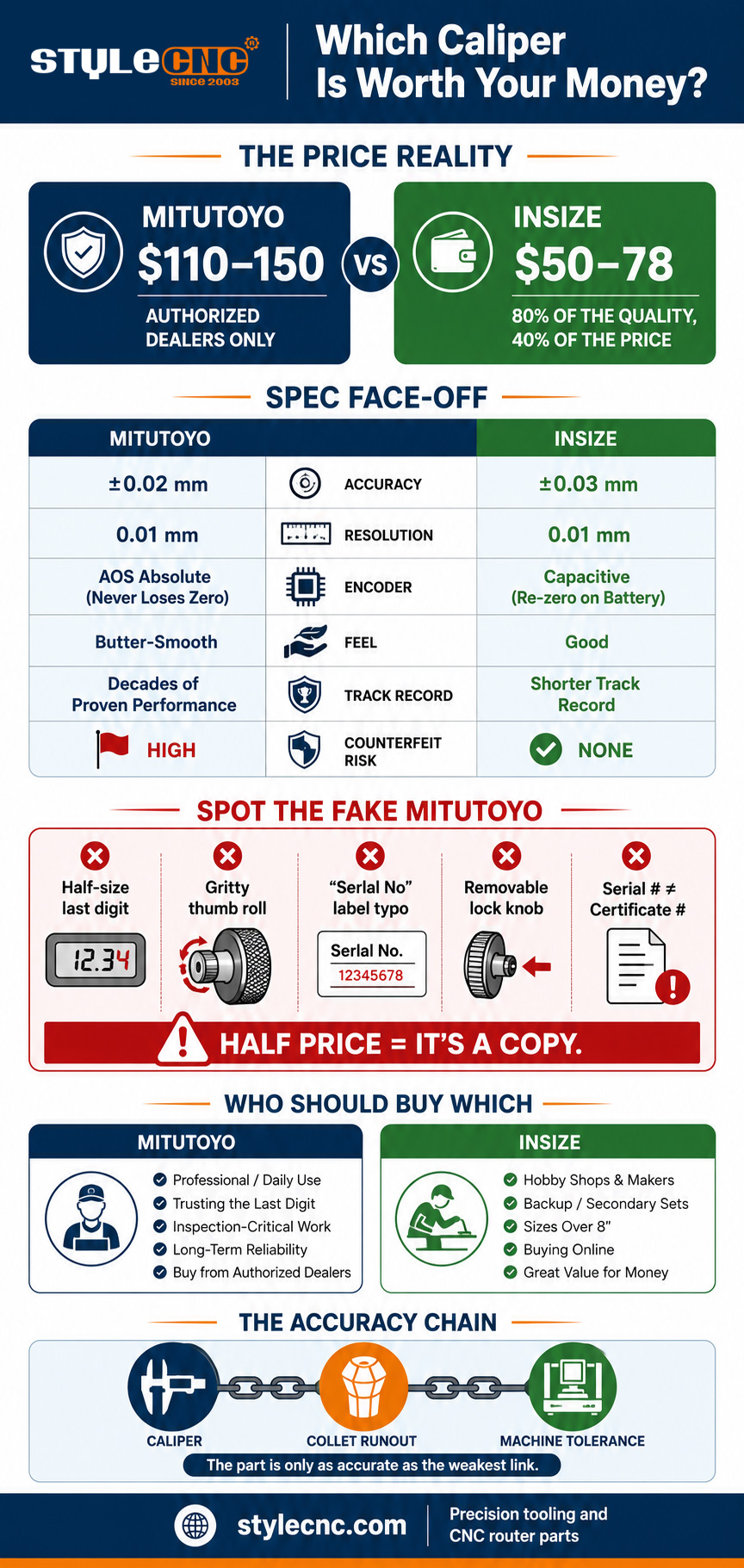
Mitutoyo is the gold standard: the 500-196-30/32 Absolute caliper (~$110 to 150 from authorized dealers) offers the AOS origin system, butter-smooth action, and decades of proven durability. Insize delivers roughly 80 percent of that quality at 40 percent of the price (~$50 to 78), with DIN 862 compliance and honest specs. Buy Mitutoyo for daily professional use; buy Insize for hobby work, backup sets, and large sizes.
The comparison is not premium versus junk. Insize is a legitimate metrology specialist, not a random import label, and the machinist community treats it as the serious budget option. The real questions are how much the Mitutoyo premium buys, when it is worth paying, and how to avoid accidentally paying Mitutoyo money for a Chinese counterfeit, which is the hidden 3rd option nobody wants.
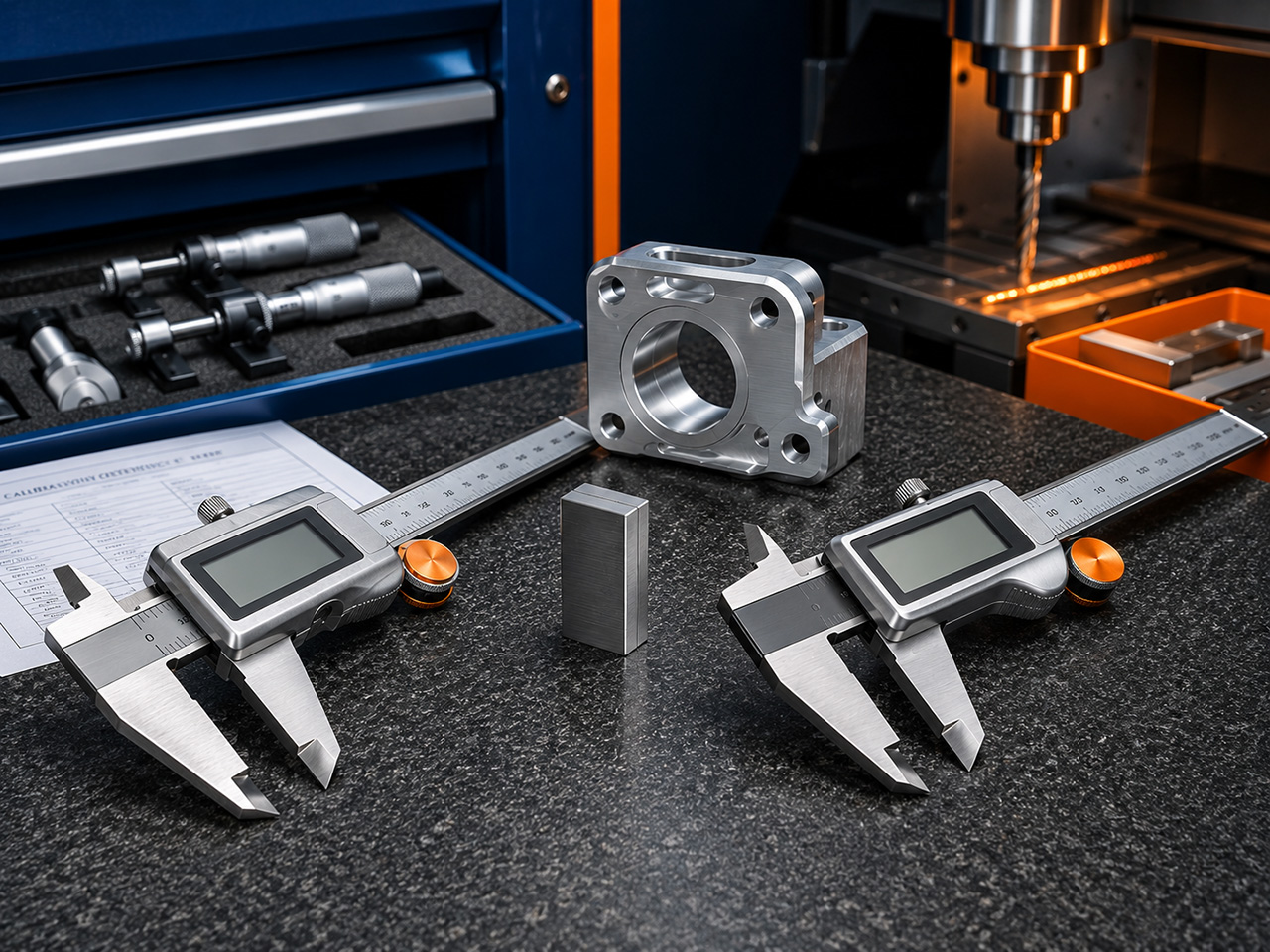
Who Actually Makes These Calipers
Mitutoyo is a Japanese metrology corporation with roughly a century of instrument-making history, in-house sensor technology, and the largest calibration infrastructure in the industry. The 500-series Digimatic caliper is widely described by distributors as the best-selling caliper in the world, and its ABSOLUTE encoder technology is proprietary.
Insize is a Chinese company that makes measuring instruments and nothing else. That specialization matters: a Practical Machinist member weighing a 12-inch purchase noted that making measuring instruments is all this company does, which made the risk feel very different from a no-name import. Insize publishes DIN and ISO compliance for its instruments, runs a global distributor network, and prices aggressively. The same forum thread captured the economics perfectly: a 12-inch Insize digital for about $78 against more than $300 for the equivalent Mitutoyo.
Head to Head: The 6-Inch Digital Standard-Bearers
The fairest comparison pits each brand's mainstream 6-inch (150 mm) digital caliper: the Mitutoyo 500-196-32 (the updated designation of the legendary 500-196-30) against the Insize 1108-150.
| Especificación | Mitutoyo 500-196-32 | Insize 1108-150 |
|---|---|---|
| Street price (authorized) | $110 a 150 | $50 a 78 |
| Precisión declarada | ±0.001 pulgadas / ±0.02 mm | ±0.0015 in / ±0.03 mm (DIN 862) |
| Precisión en el mundo real | Reviewers measure closer to ±0.0005 in | Meets stated spec; less headroom beyond it |
| Resolución | 0.0005 en / 0.01 mm | 0.0005 en / 0.01 mm |
| codificador | ABSOLUTE AOS inductive; origin survives battery change | Capacitive; re-zero after battery change |
| Mostrar | Extra-large 9 mm digits | LCD estándar |
| Salida de datos | Optional SPC (higher-cost variants) | Optional SPC output available |
| Feel and fit | Butter-smooth, no perceptible jaw slop | Good; a step down in smoothness |
| Documentación | Ships with Mitutoyo inspection certificate | Inspection certificate included |
| Natural | Made in Japan | Hecho en China |
Read the accuracy rows together and the honest picture emerges. On paper the gap is ±0.02 versus ±0.03 mm, trivial for most work. In practice, independent reviewers find genuine Mitutoyos beating their own spec, holding closer to a half-thou, while budget instruments tend to meet spec without exceeding it. For measuring to the thou, both work. For trusting the last digit, the Mitutoyo has more margin.
The Honest Verdict on Each Brand
GOLD STANDARD: Mitutoyo (500-series Digimatic) | $110 to 150 (6-inch, authorized dealers)
Ventajas: The AOS absolute encoder never loses its origin, even through battery changes, eliminating the most common digital caliper error. Fit and finish are the industry reference: forum members comparing genuine units to clones describe the real one as super smooth and flawless in repeatability. Durability is measured in decades; ten-year-old shop units are the norm, not the exception. Resale value holds.
Límites honestos: Price, and the counterfeit minefield that price created. Fakes flood online marketplaces at 25 to 50 percent of retail, complete with cloned boxes, certificates, and serial labels, and they have leaked into the used market. Buying safely means authorized dealers only, which means paying full freight. The entry Mitutoyo also lacks data output; SPC-capable variants cost more.
Veredicto: Worth every dollar for daily professional use, but only from an authorized dealer. A $50 Mitutoyo is not a deal; it is a fake.
VALUE PICK: Insize (1108-series Digital) | $50 to 78 (6-inch)
Ventajas: A genuine metrology specialist at import pricing. DIN 862 compliance, honest published specs, inspection certificate in the box, and optional SPC data output that the base Mitutoyo does not offer. The community pattern is consistent: professionals who own Mitutoyos buy Insize for 2nd sets, big sizes (a 12-inch for $78 versus $300+), and loaner drawers. No counterfeit problem, because nobody fakes a value brand.
Límites honestos: A step down in feel: smooth, but not Mitutoyo smooth, and jaw fit tolerances are looser. The capacitive encoder loses zero on battery changes. Long-term durability has a shorter public track record, and forum members note the brand is oddly under-discussed, so twenty-year longevity data simply does not exist yet. Accuracy meets spec without the headroom genuine Mitutoyos show.
Veredicto: The rational choice for hobby shops, backup sets, and any size over 8 inches. Roughly 80 percent of the Mitutoyo at 40 percent of the price.
The Counterfeit Trap: How to Spot a Fake Mitutoyo
The counterfeit problem changes the buying math more than any spec. Fake Mitutoyo calipers are so widespread on auction and marketplace sites that forum veterans apply a simple rule, stated bluntly on Practical Machinist: any seller offering a new Mitutoyo at half price is offering a copy. The fakes have circulated long enough that they now appear in the used market, sometimes sold by owners who never knew.
The community-documented tells, compiled from Practical Machinist, Home Shop Machinist, and hobbyist forum teardowns:
✗ Half-size last digit: Genuine Digimatics display all digits the same size. Fakes commonly render the final half-thou digit smaller, the single most-cited giveaway.
✗ Gritty thumb roll: Real Mitutoyos roll butter smooth. Fakes feel gritty, and side-by-side comparison makes the difference obvious.
✗ Label typos and mismatches: Documented fakes carry labels reading Serlal No instead of Serial No, and serial numbers that do not match the inspection certificate.
✗ Removable locking knob: The lock screw comes fully out of documented fakes; it does not on genuine units.
✗ Jaw-base relief grind: A hobbyist teardown across multiple genuine units found an unequal relief grind at the jaw base on every real one, while a control batch of fakes showed perfectly matched grinds.
✗ Misaligned service holes and faded packaging: Access holes that miss the adjustment screws and washed-out box printing both recur in fake reports.
The protective rule is simpler than the checklist: buy from authorized distributors at normal market price. The $111 to 150 dealer price for a 6-inch Absolute is the real price. Anything dramatically below it, however convincing the box, is the reason this section exists.
Which Caliper for Which Shop
✓ Professional machinist, daily measuring: Mitutoyo from an authorized dealer. The origin retention, feel, and decade-scale durability pay for themselves across thousands of measurements.
✓ Hobby machinist or CNC router shop: Insize. The accuracy honestly covers hobby tolerances, and the saved money buys tooling or material.
✓ 1st caliper ever: Insize now, Mitutoyo when the work demands it. Learning good measuring habits does not require the premium instrument.
✓ Large sizes (8 to 24 inch): Insize. The Mitutoyo premium scales brutally with length; the forum-documented 12-inch case was $78 versus more than $300.
✓ Production QA with data logging: Either, chosen by system: Insize offers SPC output at base price, while Mitutoyo SPC variants integrate with the deepest gauge-management ecosystem.
✓ Buying used or from marketplaces: Insize, deliberately. The used Mitutoyo market is salted with fakes; the value brand carries no counterfeit risk at all.
Why Measurement Accuracy Matters at the Machine
A caliper is the 1st link in a chain that ends at the cutting edge. Every offset you enter, every first-article check, every tool-wear adjustment routes through the instrument in your hand. A caliper reading 2 thou off does not make scrap by itself; it makes every downstream decision 2 thou wrong, and on a machine positioning to a fraction of that, the instrument becomes the weakest link in the loop.
That is the practical reason machinists debate a hand tool this fiercely: measurement discipline and machine capability rise together. It shows up in tooling as much as instruments, where spindle collet runout sets the floor on hole and slot accuracy no caliper can fix afterward; the ER-series collet range en el CNC router parts catalog is the machine-side half of the same accuracy conversation. And when cut quality itself is the question, process precision guides like the plasma cutting precision analysis y conectar fiber laser cutting precision analysis show where machine-side tolerances come from, and where a good caliper will catch them drifting.
Preguntas frecuentes
Are Insize calipers any good?
Yes, with honest context. Insize is a dedicated metrology manufacturer, not a relabeled generic, and its 1108-series digital calipers carry DIN 862 compliance at ±0.03 mm with an inspection certificate in the box. Practical Machinist members buying them note that measuring instruments are all the company makes, which is exactly why professionals use them for 2nd sets and large sizes. The trade-offs are a less silky action than Mitutoyo, zero loss on battery changes, and a shorter public durability record.
Why are Mitutoyo calipers so expensive?
You are paying for the ABSOLUTE AOS encoder that never loses its origin (even through battery changes), Japanese manufacturing with jaw fit machined to no perceptible slop, real-world accuracy that independent reviewers measure at better than the ±0.001 inch spec, and durability routinely measured in decades. Authorized-dealer pricing for the 6-inch 500-196-30/32 runs roughly $110 to 150. Whether that premium is worth it depends entirely on how many measurements per day ride on it.
How can I tell if Mitutoyo calipers are fake?
The most-cited tells from forum documentation: a half-size final digit on the display (genuine units show all digits equal), a gritty rather than butter-smooth thumb roll, label typos like Serlal No, serial numbers that do not match the certificate, a locking knob that unscrews completely out, and service holes misaligned with the adjustment screws underneath. The blunt Practical Machinist rule covers the rest: a new Mitutoyo at half price is a copy. Buy from authorized distributors only.
Is the accuracy difference between Insize and Mitutoyo noticeable?
On the spec sheet it is ±0.02 mm versus ±0.03 mm, invisible for most work. In practice, reviewers find genuine Mitutoyos holding closer to ±0.0005 inch, beating their own rating, while budget instruments meet spec without exceeding it. If your tolerances live at plus or minus a few thou, both brands measure identically well. If you routinely trust the last digit, or your caliper reading feeds machine offsets directly, the Mitutoyo margin is real.
Which caliper should a hobby machinist buy first?
The pragmatic forum consensus: start with the Insize (or equivalent honest budget instrument) and upgrade to Mitutoyo when the work demands it or the budget relaxes. A $50 to 78 Insize covers hobby tolerances with certificate-backed specs and no counterfeit risk, and the saved $70+ buys cutters or material. The exception is anyone buying secondhand: the used Mitutoyo market carries genuine fake risk, while nobody counterfeits the value brand.
Do cheap calipers affect CNC machining accuracy?
Indirectly but genuinely. The caliper does not move the machine, but it sets every offset, first-article verdict, and wear adjustment you enter. An instrument reading 0.05 mm off biases every one of those decisions by that amount, on machines that position far tighter. The fix is less about brand than discipline: verify zero before measuring, check the instrument against a gauge block or standard periodically, and match instrument accuracy to the tolerance of the work, stepping up to micrometers where calipers run out of resolution.
Lo más importante es...
Mitutoyo earns the gold-standard reputation with the AOS encoder, reference-grade feel, and accuracy headroom beyond its own spec, and the only real way to buy one is at full authorized-dealer price, because the discount channel is where the counterfeits live. Insize earns the value crown honestly: a real metrology maker delivering certificate-backed DIN 862 accuracy at 40 percent of the money, which is exactly why the professionals who own Mitutoyos keep Insize in the 2nd drawer.
Buy the instrument that matches how many measurements per day ride on it, verify it against a standard now and then, and remember the chain it belongs to: the caliper, the collets and tooling, and the machine each set a link of the final tolerance, and the part is only ever as accurate as the weakest one.