
UHMW (Ultra-High Molecular W8 Polyethylene) is generally the best material for rail slides due to its superior low-friction properties (coefficient of 0.05-0.10), exceptional wear resistance, and self-lubricating characteristics. Delrin offers better dimensional stability and machinability for precision applications, while HDPE provides a cost-effective solution for lighter-duty operations.
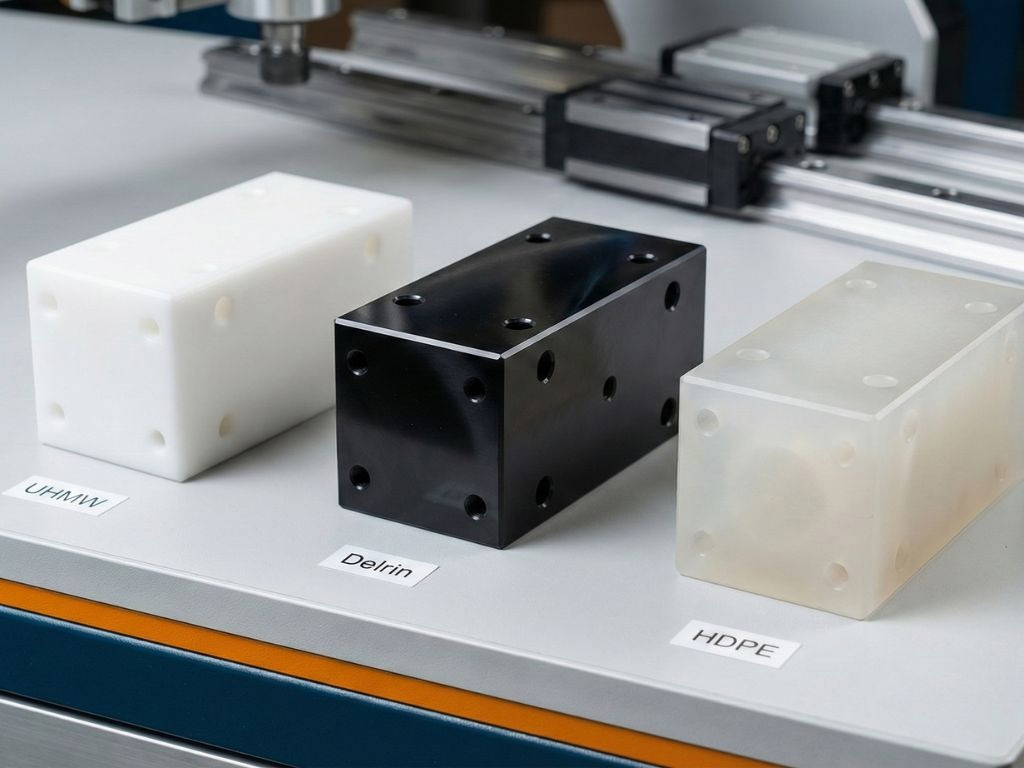
Selecting the right plastic material for rail slides directly impacts the performance, longevity, and maintenance requirements of Enrutadores CNC, linear motion systems, and automated manufacturing equipment. The choice between UHMW, Delrin, and HDPE depends on specific application demands, including load capacity, speed, environmental conditions, and budget constraints.
This comprehensive comparison examines the mechanical properties, performance characteristics, and practical applications of these 3 engineering plastics to help you make an informed decision for your rail slide system.
Understanding Rail Slide Materials
What Are Rail Slides?
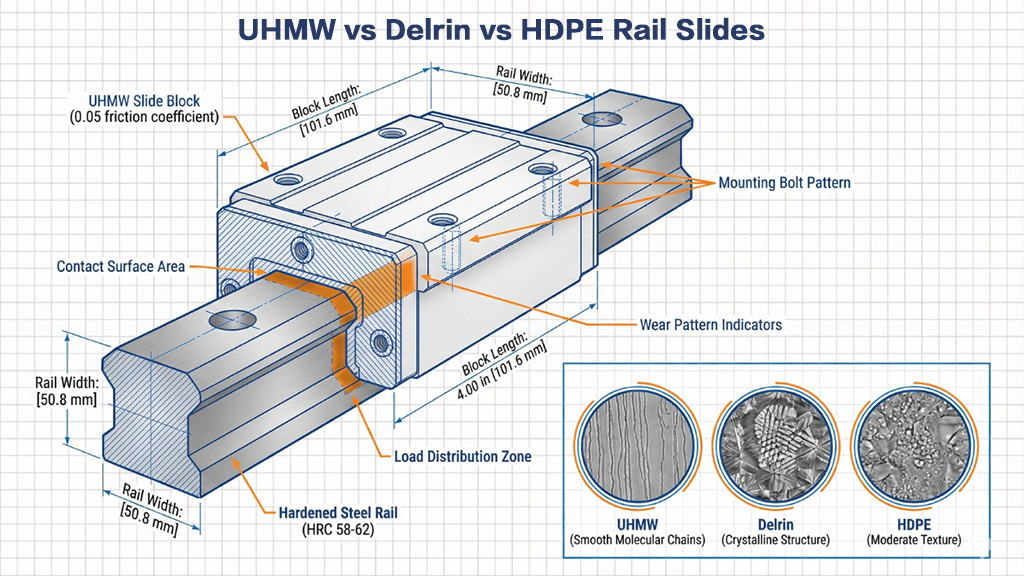
Rail slides, also known as guide blocks or bearing blocks, are components that provide smooth linear motion along carriles guía in CNC machines and linear motion systems. These components must withstand continuous friction while maintaining dimensional accuracy and minimizing wear on both the slide and the rail.
Material Definitions
• UHMW (Ultra-High Molecular W8 Polyethylene): An extremely tough thermoplastic with molecular w8 between 3.5 and 7.5 million atomic mass units, offering outstanding abrasion resistance and low friction.
• Delrin (acetal/POM): DuPont's brand name for acetal resin (polyoxymethylene), a highly crystalline engineering plastic known for dimensional stability and machinability.
• HDPE (polietileno de alta densidad): A versatile polyethylene with density ranging from 0.93 to 0.97 g/cm³, offering good chemical resistance and moderate mechanical properties.
Comparación de propiedades de materiales
| Propiedad | UHMW | Delrín (Acetal) | HDPE |
|---|---|---|---|
| Coeficiente de fricción (COF) | 0.05 - 0.10 | 0.20 - 0.35 | 0.15 - 0.25 |
| Resistencia a la abrasión | Excellent (6-10x better than carbon steel) | Bueno | Moderado a bueno |
| Resistencia a la tracción | 3,000-5,500 psi | 8,800-10,000 psi | 3,100-4,500 psi |
| Dureza (Shore D) | 60 - 65 | 80 - 85 | 66 - 73 |
| Temperatura máxima de funcionamiento | 180°F (82°C) | 200°F (93°C) | 180°F (82°C) |
| Absorción de agua (24h) | 0.01% | 0.20 -% 0.25 | 0.01% |
| Estabilidad dimensional | Moderate (higher thermal expansion) | Excellent (low thermal expansion) | Moderada |
| maquinabilidad | Difficult (soft, tends to gum up) | Excellent (machines like metal) | Bueno |
| Costo (relativo) | $$ - $$$ | $$$-$$$$ | $ |
Análisis profundo de materiales
UHMW: The Low-Friction Champion
Características de presentación: UHMW's molecular structure creates an exceptionally slippery surface with a coefficient of friction lower than Teflon when sliding on steel. This self-lubricating property reduces wear on both the slide and the rail, extending maintenance intervals significantly.
Ventajas clave:
• Outstanding abrasion resistance - UHMW outlasts carbon steel by 6-10 times in sliding applications.
• Minimal noise during operation due to vibration-damping properties.
• Chemical resistance to most acids, bases, and organic solvents.
• FDA-approved grades available for food processing equipment.
• Performs well in dirty environments without frequent lubrication.
Limitaciones a considerar:
• Lower tensile strength compared to Delrin (3,000-5,500 psi vs 8,800-10,000 psi).
• A higher coefficient of thermal expansion requires compensation in precision applications.
• Difficult to machine - soft material can gum cutting tools.
• Cannot be bonded with standard adhesives.
• Creeps under sustained loading at elevated temperatures.
Mejores aplicaciones: Tarea pesada Componentes de la fresadora CNC, high-cycle linear motion systems, conveyor rails, and applications requiring minimal maintenance or operating in contaminated environments.
Delrin: The Precision Performer
Performance Characteristics: Delrin's high crystallinity provides excellent dimensional stability and rigidity, making it ideal for precision applications requiring tight tolerances. The material machines beautifully, producing smooth surfaces without secondary operations.
Ventajas clave:
• Superior dimensional stability with low thermal expansion (coefficient of 8.1 × 10⁻⁵ /°F).
• Excellent machinability allows complex geometries and tight tolerances.
• High stiffness and tensile strength support heavier loads.
• Low moisture absorption (0.20-0.25%), maintaining dimensional accuracy.
• Good fatigue resistance for repetitive motion applications.
• Natural lubricity reduces friction without external lubrication.
Limitaciones a considerar:
• Higher coefficient of friction (0.20-0.35) compared to UHMW.
• More expensive than both UHMW and HDPE.
• Susceptible to strong acids and bases.
• Can become brittle at temperatures below -40°F (-40°C).
• UV degradation without stabilizers.
Mejores aplicaciones: Precisión hobby CNC machines, instrumentation requiring dimensional stability, applications with tight tolerance requirements, and systems where rigidity prevents deflection under load.
HDPE: The Budget-Friendly Option
Performance Characteristics: HDPE offers a balance of mechanical properties and cost-effectiveness, making it suitable for applications where performance demands are moderate and budget constraints are significant.
Ventajas clave:
• Lowest cost among the 3 materials (typically 40-60% less than UHMW).
• Good chemical resistance to acids, alcohols, and bases.
• Excellent impact strength at low temperatures.
• FDA-approved grades available for food contact.
• Easy to fabricate and machine.
• Lightw8 with a density of 0.93-0.97 g/cm³.
Limitaciones a considerar:
• Moderate wear resistance - inferior to UHMW for sliding applications.
• Higher coefficient of friction requires more frequent lubrication.
• Lower tensile strength limiting load-bearing capacity.
• Susceptible to stress cracking in certain chemical environments.
• UV degradation without stabilizers.
Mejores aplicaciones: Light-duty linear motion systems, prototype development, educational equipment, and applications where cost is the primary consideration over maximum performance.
Rendimiento en aplicaciones del mundo real
Rendimiento de fricción y desgaste
Field testing on industrial linear ATC CNC systems reveals significant performance differences:
| Parámetro de prueba | UHMW | Delrín | HDPE |
|---|---|---|---|
| Tasa de desgaste (mm³/Nm) | 1.0 × 10⁻⁶ | 3.5 × 10⁻⁶ | 5.2 × 10⁻⁶ |
| Service Life (cycles at 500N load) | 500,000+ | 200,000 - 300,000 | 100,000 - 150,000 |
| Intervalo de mantenimiento | 6-12 meses | 3-6 meses | 1-3 meses |
| Nivel de ruido (dB) | 45 - 50 | 55 - 60 | 60 - 65 |
Consideraciones sobre la capacidad de carga
While UHMW excels in friction reduction, Delrin's higher tensile strength and modulus of elasticity make it better suited for high-load applications:
• Cargas ligeras (menos de 100 libras): All 3 materials perform adequately; HDPE offers cost savings.
• Medium loads (100-500 lbs): UHMW or Delrin recommended; UHMW edges out for longevity.
• Heavy loads (over 500 lbs): Delrin preferred for its rigidity and resistance to deformation.
• Cargas de impacto: UHMW's superior impact strength prevents cracking under shock loading.
Rendimiento ambiental
Operating environment significantly affects material selection for precision CNC applications:
• Dusty/Dirty Environments: UHMW's self-lubricating properties prevent contamination from affecting performance.
• Alta humedad: UHMW and HDPE resist moisture absorption better than Delrin.
• Exposición a sustancias químicas: UHMW offers the broadest chemical resistance; Delrin is vulnerable to strong acids/bases.
• Fluctuaciones de temperatura: Delrin maintains dimensions better across temperature ranges.
• Aplicaciones al aire libre: All 3 require UV stabilizers; Delrin and HDPE are more readily available with UV protection.
Selección de materiales específicos para cada aplicación
Aplicaciones del enrutador CNC
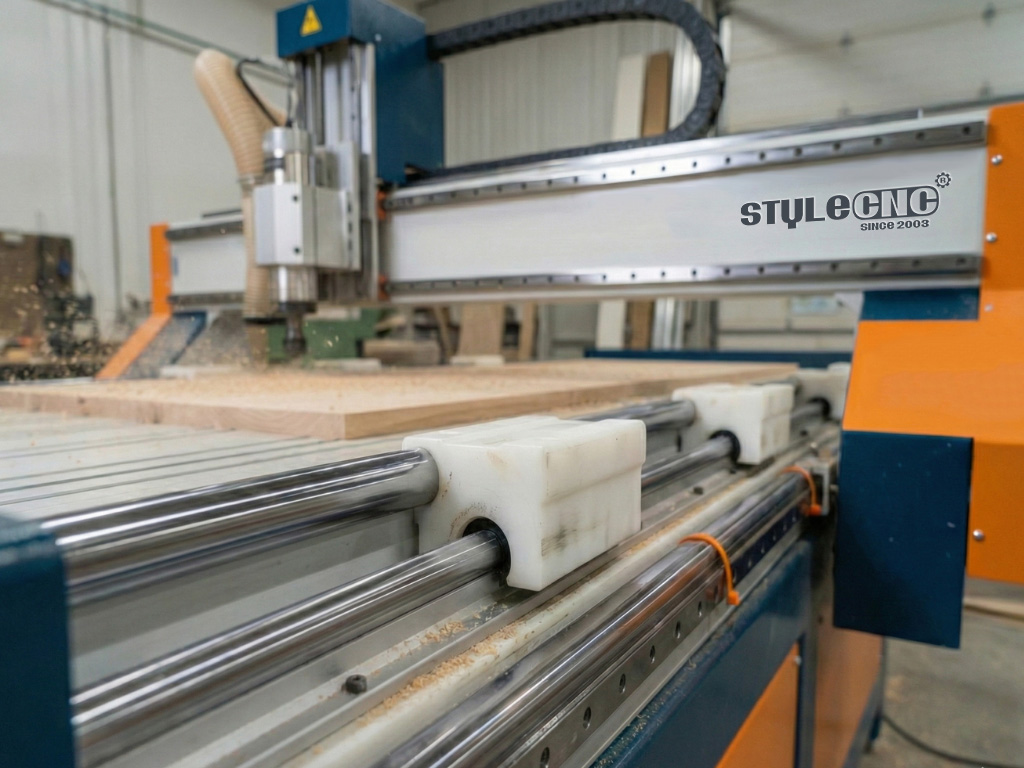
las demandas de CNC router quality and accuracy require careful material consideration:
Gantry Rail Slides
• Recommended: UHMW.
• High-cycle operation benefits from low friction and wear resistance.
• Reduced maintenance downtime in production environments.
• Vibration dampening improves surface finish quality.
Z-Axis Slides
• Recommended: Delrin.
• Vertical loading requires higher rigidity to prevent deflection.
• Dimensional stability maintains cutting depth accuracy.
• Minimal creep under sustained vertical load.
Rotary Axis Components
• Recommended: UHMW.
• Continuous rotation benefits from self-lubricating properties.
• Lower friction reduces motor load and energy consumption.
• Excellent for 4-axis and 5-axis rotary attachments.
Aplicaciones de fabricación industrial
Sistemas transportadores
• UHMW: Best for high-volume operations with abrasive materials.
• HDPE: Suitable for light-duty package handling where cost matters.
Equipo de embalaje
• Delrín: Precision requirements in filling and sealing operations.
• UHMW: Food-grade options for FDA compliance in food packaging.
Manejo de Materiales
• UHMW: Heavy-duty applications with impact loading.
• Delrín: Precision positioning in automated storage systems.
Análisis del costo total de propiedad
Initial material cost represents only a portion of total ownership expenses. A comprehensive analysis includes installation, maintenance, and replacement costs over the component lifecycle:
Cost Breakdown (Per Linear Foot for 1" × 1" Rail Slide)
| Factor de costo | UHMW | Delrín | HDPE |
|---|---|---|---|
| Material Cost (per ft) | $ 12-18 | $ 20-30 | $ 6-10 |
| Tiempo de mecanizado | High (soft material) | Low (excellent machinability) | Moderada |
| Vida útil esperada | 3-5 años | 2-3 años | 1-2 años |
| Frecuencia de mantenimiento | Semestral | Trimestral | Monthly-Bimonthly |
| Costo total en 5 años | $ 80-120 | $ 120-180 | $ 90-150 |
Key Insight: While HDPE has the lowest upfront cost, frequent replacement and maintenance can result in a higher total cost over 5 years compared to UHMW in high-use applications.
Mejores prácticas de instalación y mantenimiento
Pautas de instalación
Proper installation extends service life regardless of material choice. Follow Mejores prácticas de mantenimiento de CNC:
Preparación de la superficie
• Clean rail surfaces thoroughly, removing dirt, oil, and oxidation.
• Verify rail straightness within 0.002" per foot for precision applications.
• Deburr sharp edges that could cut into plastic slides.
• Apply thin lubricant film on rail before initial installation.
Slide Mounting
• Allow thermal expansion clearance: 0.010" per foot for UHMW, 0.005" for Delrin.
• Use flat washers to distribute clamping forces evenly.
• Torque fasteners to manufacturer specifications to prevent over-compression.
• Install slides with natural bow (if present) oriented away from the rail.
Programas de mantenimiento
UHMW Maintenance
• Mensual: Visual inspection for chips, cracks, or excessive wear.
• Trimestral: Clean accumulated debris from rail and slide surfaces.
• Bianualmente: Apply light lubrication if operating in dry environments.
• Anualmente: Measure slide thickness; replace when worn 30%
Delrin Maintenance
• Mensual: Check for dimensional changes due to moisture absorption.
• Trimestral: Clean and inspect for surface cracks or stress marks.
• Trimestral: Apply dry lubricant (PTFE spray) to reduce friction.
• Bianualmente: Verify dimensional accuracy with precision measurement.
HDPE Maintenance
• Quincenal: Visual inspection for wear and deformation.
• Mensual: Clean and lubricate with light oil.
• Trimestral: Replace slides showing visible wear or compression.
Preguntas Frecuentes
Can I use HDPE instead of UHMW to save money?
HDPE can substitute for UHMW in light-duty applications with loads under 100 pounds and intermittent use. However, HDPE's higher friction coefficient and lower wear resistance will require more frequent replacement and maintenance, potentially negating initial cost savings in high-cycle applications.
Why is Delrin more expensive than UHMW?
Delrin's higher cost reflects its complex manufacturing process involving high-purity feedstock and precise polymerization control. The material's superior dimensional stability, machinability, and mechanical properties justify the premium in applications requiring tight tolerances and rigidity.
How do I prevent UHMW from gumming up my cutting tools?
Use sharp, high-speed steel or carbide tools with positive rake angles. Maintain high cutting speeds (500-800 sfm) with light feeds. Apply coolant or compressed air to remove chips continuously. Consider using tools specifically designed for plastics with polished flutes.
Which material handles temperature variations best?
Delrin offers the best dimensional stability across temperature ranges due to its low coefficient of thermal expansion (8.1 × 10⁻⁵ /°F vs 11 × 10⁻⁵ /°F for UHMW). However, all 3 materials should include expansion allowances in precision applications experiencing significant temperature swings.
Can these materials be used outdoors?
All 3 materials degrade under UV exposure without stabilizers. UV-stabilized grades are available for Delrin and HDPE. UHMW naturally has better UV resistance, but should still use stabilized versions for prolonged outdoor exposure. Carbon black filled grades offer the best UV protection for all materials.
How long should rail slides last in typical CNC applications?
Expected lifespan varies significantly based on load, speed, and maintenance. UHMW typically lasts 3-5 years in production CNC environments with 8-hour daily operation. Delrin lasts 2-3 years under similar conditions. HDPE requires replacement every 1-2 years. Proper maintenance and appropriate material selection for the application can extend these timeframes by 30-50%.
Does rail material (steel vs aluminum) affect plastic slide choice?
Yes. Hardened steel rails pair best with UHMW or Delrin due to the rail's superior wear resistance. Aluminum rails are softer and can show wear patterns from harder plastics like Delrin. For aluminum rails, UHMW is preferred as its lower friction reduces rail wear. Anodized aluminum rails perform better with any plastic slide material.
Can I mix materials on the same machine?
Mixing materials is acceptable and sometimes advantageous. For example, using Delrin on the Z-axis for rigidity while using UHMW on X and Y axes for low friction optimizes performance. Ensure all slides have similar friction characteristics to prevent uneven wear and motion issues.
Tomando su decisión final
Material selection for rail slides requires balancing performance requirements, environmental conditions, and budget constraints. Each material excels in specific applications:
Choose UHMW when:
• Low friction and minimal wear are top priorities.
• Operating in dusty, contaminated, or outdoor environments.
• High-cycle operation demands extended maintenance intervals.
• Noise reduction is important for operator comfort.
• Self-lubricating properties reduce maintenance complexity.
Choose Delrin when:
• Dimensional stability and precision are critical.
• Higher loads require greater rigidity and strength.
• Tight tolerances must be maintained over time.
• Complex geometries benefit from excellent machinability.
• Operating in controlled temperature and humidity environments.
Choose HDPE when:
• Budget is the primary constraint.
• Light-duty applications with minimal wear demands.
• Prototype development requires inexpensive testing.
• Easy availability and standard stock sizes are important.
• Frequent replacement is acceptable in the maintenance schedule.
For most industrial CNC applications, UHMW provides the optimal balance of performance and longevity. Precision applications benefit from Delrin's dimensional stability, while HDPE serves well in budget-conscious or light-duty scenarios. Proper installation, regular maintenance, and appropriate material selection ensure years of reliable linear motion performance.
When upgrading or maintaining your CNC equipment, consult with material suppliers or machine manufacturers to verify material compatibility and optimal specifications for your specific application requirements.